


10 Top Colonial Sites in Puerto Rico to See

The top colonial sites Puerto Rico offers are not museum pieces behind glass. They are forts where trade winds still sweep through stone tunnels, plazas that fill with music after sunset, and centuries-old streets made for wandering without a schedule. For travelers who want more than a quick photo at a fortress, these places reveal how the island became a crossroads of Spanish empire, Caribbean culture, and Puerto Rican identity.
Colonial history is complex, and that complexity is part of what makes these stops meaningful. Spain built San Juan into one of the Americas' most heavily defended ports while Indigenous Taíno communities, enslaved Africans, soldiers, artisans, and settlers shaped the island's culture under unequal conditions. Visit with curiosity, take time to read the exhibits, and let the details add depth to the adventure.
Start with Old San Juan's Great Fortifications
Old San Juan is the natural starting point for any colonial route. Its blue cobblestones, pastel facades, and narrow streets create a beautiful setting, but the enormous walls tell the bigger story. The city was built to protect a strategic harbor, and its defenses evolved for more than 400 years.
1. Castillo San Felipe del Morro
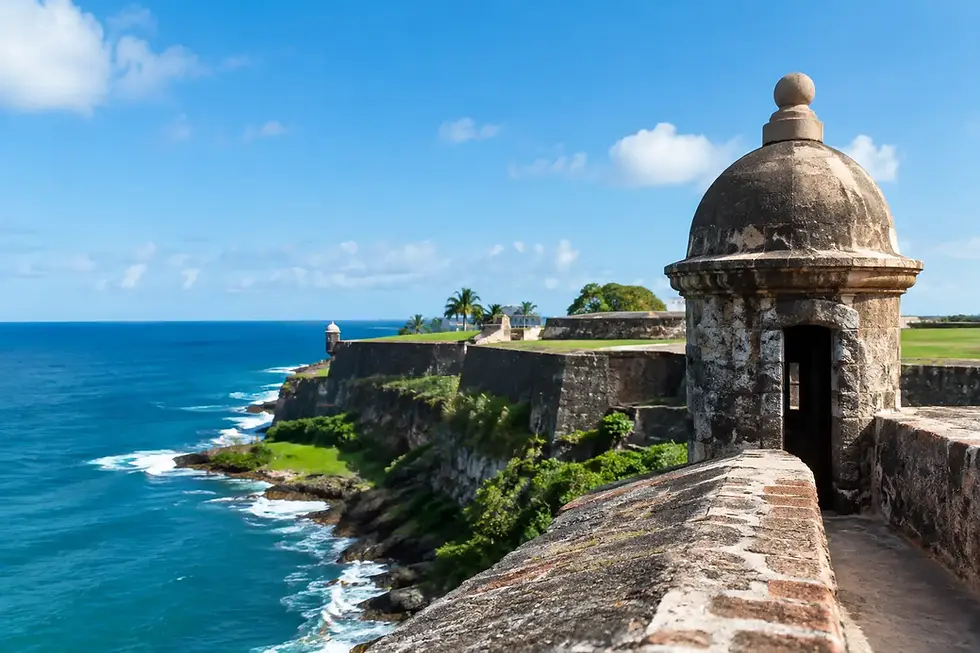
El Morro is the fortress most visitors picture when they imagine Puerto Rico. Perched at the entrance to San Juan Bay, its stacked levels, garitas, and long green lawn make it unforgettable from every angle. The first fortifications began in the 1500s, then expanded as attacks and new military technology demanded stronger defenses.
Give yourself enough time to explore beyond the postcard view. Walk the ramps, peer into the low-ceilinged rooms, and notice how the ocean-facing batteries were designed to control access to the harbor. Go earlier in the day for cooler temperatures and fewer crowds, then linger on the lawn for that wide-open Atlantic view.
2. Castillo San Cristóbal
If El Morro guarded the sea, Castillo San Cristóbal defended San Juan from attacks over land. It is larger than El Morro and rewards travelers who enjoy getting lost in passages, tunnels, and lookout points. Its ingenious layout included outer defenses and a dry moat designed to make an advancing army work for every foot of ground.
San Cristóbal can feel more hands-on because there is so much to move through. Families will appreciate the room to explore, while history-minded visitors can compare its later defensive design with El Morro's harbor focus. Seeing both fortresses is worthwhile, not repetitive.
3. Paseo del Morro and the City Walls
For a quieter way to experience the fortifications, follow the waterfront path beneath San Juan's walls. Paseo del Morro gives you a ground-level sense of their sheer scale, with the bay on one side and centuries of masonry rising on the other. It is especially memorable late in the afternoon, when the light softens and the cruise-ship bustle begins to fade.
This is one of the best reminders that Old San Juan is not a single attraction. The walls, gates, streets, and forts form one living historic landscape. Wear shoes with traction, bring water, and expect uneven surfaces throughout the old city.
See the Civic and Spiritual Heart of Colonial San Juan
Military architecture tells only part of the story. A few blocks inland, churches, homes, and civic buildings reveal how colonial San Juan functioned as a capital and community.
4. La Fortaleza
La Fortaleza began in the 1530s as a defensive structure and later became the governor's residence. Its bright blue exterior and waterfront setting make it one of Old San Juan's most recognizable sights. It remains an active government building, so access and tour availability can vary, but even viewing it from outside is worth adding to your walk.
The building offers a useful contrast with the giant castles nearby. It shows how political power, daily administration, and military control were closely tied in the colonial city. Check current visiting rules before planning your day around an interior tour.
5. Catedral Basílica Menor de San Juan Bautista
The cathedral is one of the oldest surviving churches in the Americas, with origins dating to the early 1500s. Its present appearance reflects rebuilding and changes over time, including a reconstruction after a hurricane. Inside, the calm white interior feels worlds away from the bright, busy streets outside.
It is also the resting place of Spanish explorer Juan Ponce de León. Whether or not you care about that particular name, the cathedral is a powerful place to pause and consider how faith, conquest, and social hierarchy shaped colonial life. Dress respectfully, especially if services are taking place.
6. Capilla del Cristo
At the end of Cristo Street, the tiny Capilla del Cristo sits above the old city wall with a view toward the water. According to local tradition, it was built after a rider survived a near-fatal fall during a horse race. The story gives the chapel its character, while its location makes it a peaceful stop amid a busy walking route.
Pair it with the nearby Parque del Niño, Pigeon Park, and the streets around it. This corner of Old San Juan is ideal for slowing down, looking at balconies and doorways, and letting the city surprise you.
7. Casa Blanca
Built in the 1520s for the Ponce de León family, Casa Blanca is among the island's oldest residences. The building has changed considerably over the centuries, yet its gardens, thick walls, and hillside setting still offer a more intimate view of colonial-era domestic life than the grand forts do.
It is a smart addition for travelers who want to move beyond cannons and ramparts. The gardens alone provide a welcome break from the sun, and the site helps connect Puerto Rico's early Spanish settlement with the families who benefited from colonial rule.
Add Ballajá for a Different Colonial-Era Perspective
8. Cuartel de Ballajá
Near El Morro, the massive Cuartel de Ballajá was constructed in the 1800s to house Spanish troops and their families. It is later than the earliest colonial sites, but it belongs on a route because it shows how Spanish military presence continued to shape the city right up to the end of Spanish rule in 1898.
The airy central courtyard is a striking contrast to the enclosed fortresses. Depending on current programming, you may find cultural exhibits, dining, or events nearby. It is an easy stop to combine with El Morro and gives the area more texture than a fort-only visit.
Make Time for San Germán
9. Porta Coeli in San Germán
For one of the most rewarding day trips beyond San Juan, head southwest to San Germán. The town's historic center feels slower and more residential, and Porta Coeli is its signature colonial treasure. Built in the early 1600s as a convent and church, it is one of the oldest religious structures in Puerto Rico.
The building's weathered simplicity is the appeal. Rather than commanding a harbor, it speaks to the spread of religious institutions and Spanish settlement beyond the capital. San Germán is a strong choice for repeat visitors or anyone who wants to trade Old San Juan's energy for a less hurried historic stop.
10. Plaza Santo Domingo and the Historic Center
Do not rush away after Porta Coeli. San Germán's historic center has colonial-era streets, handsome facades, and plazas that invite a slower walk. The pleasure here is less about checking off major landmarks and more about noticing the town's scale, architecture, and everyday rhythm.
This stop works best if you have a rental car and a full day to explore the southwest. It also pairs well with beaches, coffee country, or a scenic drive, depending on your route. Colonial history does not exist apart from the landscapes and communities around it.
Build a Route That Leaves Room to Wander
A first-time visitor can cover El Morro, San Cristóbal, the cathedral, La Fortaleza's exterior, Capilla del Cristo, and Casa Blanca in one ambitious Old San Juan day. Two days is better if you want time for galleries, meals, and those unplanned turns that often become the favorite memories. Add San Germán on a separate day rather than trying to squeeze it between airport arrival and dinner reservations.
The trade-off is simple: packing in every landmark delivers a fast overview, while choosing fewer sites lets their stories land. A self-paced audio tour can keep the route organized without pulling you away from a viewpoint, a bakery, or a quiet side street when something catches your eye. Coquí Guides helps independent travelers hear local context as they explore on their own time.
Bring sun protection, water, and comfortable walking shoes. Old San Juan's cobblestones are beautiful but uneven, and fortress stairways can be steep. Most of all, leave a little white space in the itinerary. The best colonial discovery may be the small carved doorway, shaded plaza bench, or harbor view you find between the famous stops.


Comments