


Local Stories Behind Puerto Rico Landmarks
- Coquí Guides

- 2 days ago
- 6 min read
A cannon pointing over the walls of El Morro is impressive. Knowing that generations of San Juan families watched those same walls for ships, storms, and news from abroad is what makes the view stay with you. The local stories behind Puerto Rico landmarks turn famous photo stops into places with memory, tension, pride, and personality.
That is the difference between checking landmarks off an itinerary and actually feeling connected to the island. Puerto Rico’s forts, plazas, forests, lighthouses, and carved stones are not frozen museum pieces. They sit within living communities, shaped by Taíno heritage, Spanish colonial rule, African traditions, migration, resilience, and everyday island life.
Old San Juan’s Forts Are More Than Big Walls
Castillo San Felipe del Morro, usually called El Morro, is often the first landmark visitors recognize. Its dramatic position at the entrance to San Juan Bay was strategic for centuries: whoever controlled the fort controlled access to one of the Caribbean’s most important ports.
But the story is not only about Spain defending its colony. The fort reflects the labor of soldiers, enslaved people, craftspeople, and local residents whose lives were tied to the city’s defenses. Its thick walls survived attacks by English and Dutch forces, and later stood through the changing political reality of Puerto Rico after 1898.
Walk the grounds slowly and you will notice that El Morro feels both grand and personal. On weekends, locals and visitors fly kites across the broad lawn outside the fort. That tradition gives the site a different energy: a former military stronghold now filled with wind, laughter, bright colors, and family gatherings. It is a reminder that Puerto Rico does not preserve history by keeping it distant. It lets history live alongside the present.
Castillo San Cristóbal and the Story of a Walled City
A short distance away, Castillo San Cristóbal tells a related but distinct story. It was built to defend San Juan from attacks coming over land, making it part of a larger system of walls, gates, tunnels, and lookout points.
Many travelers focus on its scale, and for good reason. It is one of the largest Spanish fortifications in the Americas. Yet the most revealing detail may be how the fort connects to the city around it. San Juan was once a tightly defended place where entrances were monitored and the ocean could mean commerce, opportunity, invasion, or escape.
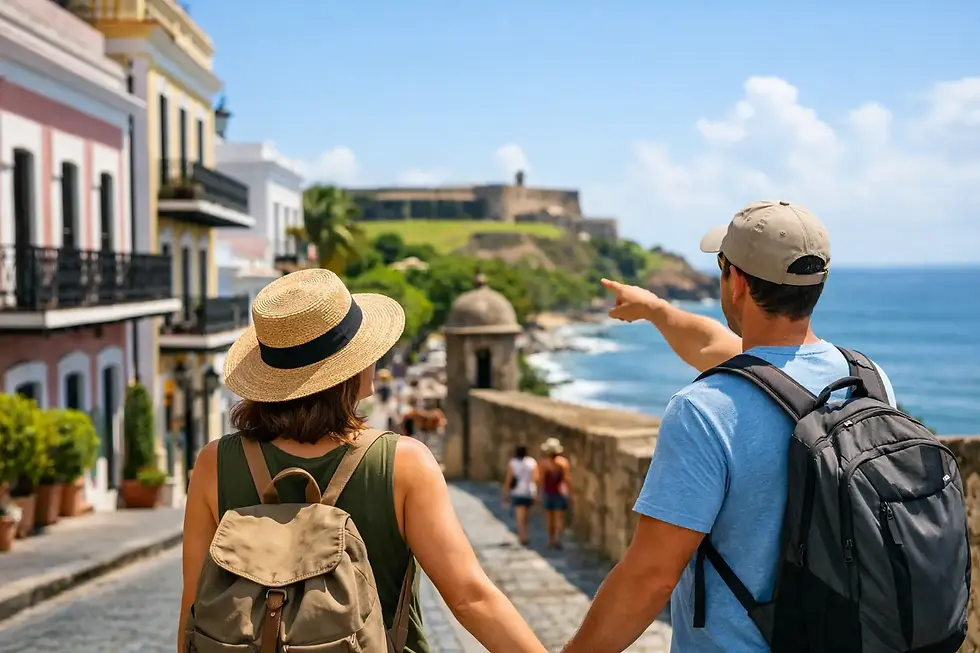
The old city walls still frame daily life. Residents head to work, visitors wander cobblestone streets, and musicians perform near plazas that have witnessed centuries of change. When you stand at a sentry box overlooking the Atlantic, imagine the person posted there - not as a character in a costume drama, but as someone enduring heat, rain, isolation, and uncertainty while watching the horizon.
La Fortaleza Holds a More Complicated Kind of History
La Fortaleza’s blue-and-white facade is one of Old San Juan’s most photographed sights. Officially, it is the governor’s residence, and it has served as a center of political power for centuries. Originally constructed as a defensive fort, it eventually became more residential and ceremonial than military.
Its importance is not limited to architecture. La Fortaleza represents the evolving question of who governs Puerto Rico and how island residents make their voices heard. The street outside has been the setting for celebrations, demonstrations, and moments of public debate. That makes it a landmark best understood with context, not simply a quick stop for a photo.
Visitors should appreciate the building’s beauty while remembering that it remains part of a living civic landscape. In Puerto Rico, history is rarely tucked away behind velvet ropes. Often, it is right on the street in front of you.
El Yunque’s Story Begins Before the Trailhead
El Yunque National Forest is famous for waterfalls, lush trails, and the call of the coquí frog. The forest’s deeper story, however, begins with the Taíno people, who understood these mountains as a sacred and life-giving landscape. The name Yunque is often connected to Yúcahu, a Taíno deity associated with fertility and the mountains.
The rainforest also holds a practical role in the island’s life. Its high elevations capture rain and feed rivers that support communities beyond the forest boundary. This is why El Yunque is not just a beautiful place to visit. It is part of a larger ecological system that Puerto Ricans depend on.
After hurricanes, the forest’s story becomes especially visible. Trails may close, trees lose their canopy, and landslides alter familiar routes. Then, slowly, green returns. Visiting with that perspective makes the rainforest feel less like a backdrop for a swim and more like a powerful example of recovery.
Listen for the coquí after dark or near wet areas. That tiny call is not just a pleasant soundtrack. For many Puerto Ricans, it is an immediate sound of home.
Local Stories Behind Puerto Rico Landmarks in the Center of the Island
Not every meaningful landmark is a fortress or a famous beach. In the mountain town of Jayuya, La Piedra Escrita offers a direct connection to Puerto Rico’s Indigenous past. The large boulder bears petroglyphs - carved images whose exact meanings are still debated.
That uncertainty is part of what makes the site compelling. Visitors may want a simple answer about what every symbol means, but history does not always provide one. The carvings invite respect rather than invention. They point to a sophisticated Indigenous culture that existed long before European arrival and continues to shape Puerto Rican identity today.
Nearby rivers and green mountain slopes make it easy to see why this area mattered to early communities. Water, shelter, fertile land, and access through the interior all influenced where people lived. A stop at La Piedra Escrita is strongest when paired with time in Jayuya itself - a meal, a conversation, or a slow drive through the mountains. The setting is part of the story.
Cabo Rojo’s Lighthouse Carries a Coastal Warning
At the southwestern edge of the island, Los Morrillos Lighthouse stands above limestone cliffs and intensely blue water. Its white structure is striking, but the location was chosen for function, not just beauty. Built in the late 19th century, the lighthouse helped guide ships through the dangerous waters near Cabo Rojo’s coast.
The surrounding landscape adds another layer. Salt flats, dry forest, cliffs, and offshore waters create an environment very different from the humid northeast. Puerto Rico is often presented as one uniform tropical destination, but a drive to Cabo Rojo makes that idea disappear quickly.
The lighthouse story is also a lesson in perspective. Looking outward, you see the vast Caribbean. Looking back toward the island, you see a rugged coastline shaped by wind, salt, and time. Plan for sun and heat here, especially midday, and respect closed paths or barriers near the cliffs. The most unforgettable view is never worth a risky step.
Ponce’s Parque de Bombas Has a Community Pulse
Ponce’s red-and-black Parque de Bombas is one of Puerto Rico’s most recognizable buildings. It began as a pavilion for an 1882 exhibition, then became a working firehouse. Its bold colors and wooden design make it instantly memorable, but the building’s heart is its link to public service.
For decades, firefighters responded from this structure to protect the city. That gives the landmark a human scale. It is not only about an unusual facade; it is about neighbors helping neighbors during emergencies, celebrations, and ordinary life in one of the island’s most culturally distinctive cities.
Ponce rewards travelers who linger. Its central plaza, museums, music, and architecture create a fuller picture than any single building can offer. If Old San Juan tells a story of colonial defense and capital-city power, Ponce often feels more like a story of regional identity, artistic ambition, and civic pride.
How to Hear More Than the Official Version
Landmarks deserve attention, but the way you experience them matters. A plaque can provide dates. Local context can tell you why those dates still matter.
Start by giving yourself more time than a standard tour bus schedule allows. At a fort, pause at the overlooked lookout rather than rushing to the main viewpoint. In a plaza, notice who uses it in the morning versus the evening. In El Yunque, learn what conditions affect a trail before arriving, because weather can change the experience completely.
Audio-guided exploration can be especially useful for independent travelers who want structure without being tied to a group. Coquí Guides helps travelers move at their own pace while hearing the stories that give landmark visits more depth. It is a practical middle ground: local insight without sacrificing the freedom to take the long way, stop for a roadside bakery, or stay an extra twenty minutes when a place surprises you.
There is also a respectful side to storytelling. Not every story is yours to retell casually, and not every landmark needs a dramatic legend attached to it. When details are uncertain, let them remain uncertain. When a place is sacred, protected, or part of a working community, treat it accordingly. Curiosity is best when it comes with care.
Puerto Rico’s landmarks become unforgettable when you let them be more than scenery. Stand on the walls, listen to the rainforest, follow the streets beyond the postcard angle, and leave room for the story that is still unfolding around you.


Comments